
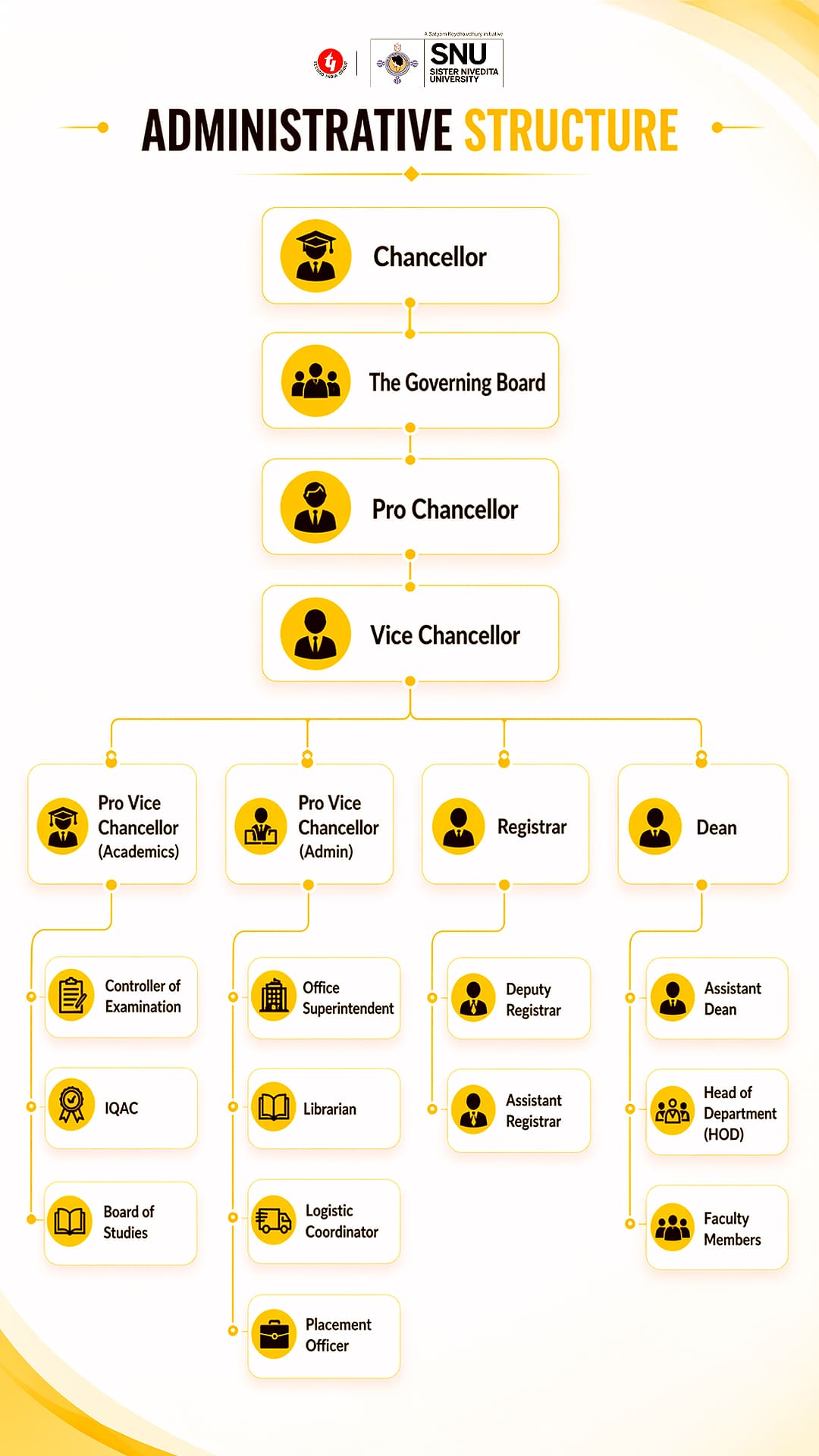
ADMINISTRATIVE STRUCTURE

OFFICERS OF UNIVERSITY

The Governing Board

1. Constitution of the Governing Board
  • The Governing Board of the University shall consist of the Chancellor as Chairman, representatives of the Sponsoring Society, Vice-Chancellor, nominated Deans, academicians, experts from various disciplines, industrial sector representatives, and the Registrar as Secretary.
2. Supreme Authority of the University
  • The Governing Board shall be the supreme authority of the University and all powers and functions conferred to the University under the Act shall be exercised by the Governing Board.
3. Powers of the Governing Board
  • The Governing Board shall provide general supervision, control the functioning of the University, frame Statutes, Regulations and Ordinances, manage funds, create or abolish posts, review decisions of authorities, prepare budget and annual report, and lay down academic and administrative policies.
4. Financial and Administrative Responsibilities
  • The Governing Board may borrow or invest University funds on recommendation of the Finance Committee and may recommend voluntary winding up of the University in consultation with the Sponsoring Society and State Government if necessary.
5. Term of Office of Members
  • The term of office of members of the Governing Board, including re-nomination or resignation, shall be as provided in the Statutes.
6. Meetings of the Governing Board
  • The Governing Board shall meet at least three times in a calendar year.
7. Quorum for Meetings
  • The quorum for meetings of the Governing Board shall be seven members.

The Governing Board Members

The Executive Council

1. Executive Council
  • The constitution, powers and functions of the Executive Council shall be provided by the Statutes of the University.
2. Officers of the University
  • The officers of the University may be declared by the Statutes and shall include the Chancellor, Vice-Chancellor, Pro-Vice-Chancellor, Deans, Registrar, Law Officer, Chief Finance Officer and Controller of Examinations.
3. Constitution of Authorities and Bodies
  • The Statutes shall provide for the constitution, powers and functions of the authorities and other bodies of the University constituted under the Act.
4. Appointment of Key Officers
  • The Statutes shall define the terms, conditions, manner and procedure of appointment of the Vice-Chancellor, Registrar, Law Officer, Chief Finance Officer, Controller of Examinations, other officers and teachers, along with their powers and functions.
5. Service Conditions and Dispute Resolution
  • The Statutes shall provide for service conditions of employees and procedures for arbitration in disputes involving officers, teachers, employees and students.
6. Academic Benefits and Admissions
  • The Statutes shall include provisions regarding honorary degrees, tuition fee exemptions, scholarships, fellowships, admission policies, reservation of seats and number of seats in different courses, in accordance with relevant Regulatory Bodies.
7. Other Necessary Provisions
  • The Statutes may include such other provisions as may be necessary for the proper functioning of the University.
8. First Statutes of the University
  • The First Statutes of the University shall be made by the Governing Board and submitted to the State Government for approval.

The Academic Council

1. Definition of Academic Council
  • "Academic Council" means the Academic Council of the University.
2. Constitution of the Academic Council
  • The Academic Council shall consist of the Chancellor, the Vice-Chancellor and such other members as may be provided for by the Statutes.
3. Chairperson of the Academic Council
  • In the absence of the Chancellor, the Vice-Chancellor may act as the Chairperson of the Academic Council.
4. Principal Academic Body
  • The Academic Council shall be the principal academic body of the University and shall coordinate and exercise general supervision over the academic policies of the University, subject to the provisions of the Act, rules and Statutes.
5. Quorum for Meetings
  • The quorum for meetings of the Academic Council shall be such as may be provided for by the Statutes.
6. Supervision of Academic Policies
  • The Academic Council shall exercise general supervision over academic policies and give directions regarding methods of instruction, evaluation of research and improvement of academic standards.
7. Inter-Faculty Coordination
  • The Academic Council may bring about inter-faculty coordination and establish or appoint committees or boards for undertaking projects on an inter-faculty basis.
8. Academic Matters of General Interest
  • The Academic Council may consider matters of general academic interest on its own initiative or those referred by the Faculty Councils, and take appropriate action thereon.
9. Suggestion of Regulations
  • The Academic Council may suggest framing of Regulations consistent with the Act, rules, Statutes and Ordinances regarding academic functioning, discipline, residence, admissions, fellowships, studentships, fee concessions, corporate life and attendance.

Board of Research Studies

1. Constitution of Board of Research Studies
  • There shall be a Research Board constituted for promoting and supervising research activities of the University.
2. Chairman of the Research Board
  • The Vice Chancellor shall be the Chairman of the Board of Research Studies.
3. Members of the Research Board
  • The Deans and Directors of the School Councils shall serve as Members of the Board.
4. Academic Representatives
  • Professors and Associate Professors of the University shall be Members of the Research Board.
5. Expert Members
  • Three experts nominated by the Governing Board for a period of three years shall serve as Members of the Board.
6. Member Secretary
  • One Professor nominated by the Vice Chancellor shall act as the Member Secretary of the Board.
7. Functional Structure of the Board
  • The Board of Research Studies shall function in three parts: University Research Committee (URC), Departmental Research Committee (DRC), and Student Research Committee (SRC).

The Finance Committee

1. Constitution of Finance Committee
  • There shall be a Finance Committee with the Chancellor as Chairman.
2. Powers and Functions of Finance Committee
  • The constitution, powers and functions of the Finance Committee shall be such as may be provided for by the Statutes.
3. Maintenance of Accounts
  • The University shall maintain proper accounts and relevant records, and prepare an annual statement of accounts including the income and expenditure account and balance sheet in the form and manner prescribed by Regulations.
4. Internal Financial Controls
  • The University shall adopt a proper system of internal checks, balances and controls in the discharge of its finance, accounting and auditing functions as provided by the Regulations.
5. Annual Audit of Accounts
  • The accounts of the University shall be audited at least once every year by a statutory auditor who shall be a Chartered Accountant as defined in the Chartered Accountants Act, 1949, appointed by the Governing Board.
6. Submission and Publication of Accounts
  • The annual statement of accounts together with copies of the audit report shall be submitted to the Governing Board and the State Government, and thereafter published by the Governing Board.

Board of Studies

1. Status and Function of Board of Studies
  • The Board of Studies is a statutory body and reports to the Academic Council through the concerned Dean. Each Academic Department shall have a Board of Studies to handle matters such as introduction of new academic programmes, revision of programmes or courses, and review of academic rules.
2. Composition of the Board of Studies
  • The Board of Studies shall consist of the Head of the Department as Chairman, two Associate Professors by rotation according to seniority, two Assistant Professors by rotation according to seniority, at least two external members co-opted for expertise in the concerned profession or industry in consultation with the Vice Chancellor, and a Secretary nominated by the Head of the Department.
3. Meetings of the Board of Studies
  • The Board of Studies shall meet as often as necessary but not less than two times during the academic year or semester.
4. Notice and Agenda of Meetings
  • A notice of at least fifteen days shall be given for every meeting along with the agenda prepared with the approval of the Chairman of the Board of Studies.
5. Conduct of Meetings
  • Every meeting shall be presided over by the Chairman. The Secretary shall finalize the minutes of proceedings as soon as possible after the meeting. Decisions shall be taken by simple majority and shall come into force only after approval by the Academic Council through recommendation of the concerned Dean.
6. Quorum
  • The quorum for a meeting of the Board of Studies shall be five members present in person.
7. Powers of the Board of Studies
  • The Board of Studies may review programme structures, course syllabi, academic rules and teaching standards, introduce new programmes, recommend increase of intake in programmes, develop educational pedagogy such as group discussions, seminars and projects, and consider any other academic matter.
8. Role of the Board of Studies
  • The Board of Studies shall collect feedback from industry and employing agencies, monitor and review programme structures, compare courses with other institutes, assess market requirements and modern trends, update courses and programmes, and recommend amendments while preserving the objectives, vision, mission, academic standards and evaluation methodology of the Institute.
9. Recommendations and Approval
  • All decisions and recommendations of the Board of Studies shall be recorded in minutes and forwarded through the concerned Dean to the Academic Council for consideration, approval and further necessary action.

Advisory Board Members

1. Dr. Rob Roy
  • Dr. Rob Roy is a distinguished entrepreneur in wireless and VLSI system design and serves as Chief Advisor, Entrepreneurship & International Programs at SNU. He is also Executive Vice President & General Manager, Innovation Hub at TEOCO, a telecom software company based in Fairfax, Virginia, USA.
  • He has co-founded several successful startups including Mobilian, Zenasis Technologies, Wi2Wi and Avnera, all of which were later acquired by major global corporations.
  • He has held engineering and executive leadership roles at NEC, Intel and Atrenta, and has also served as adjunct faculty at Princeton University and the University of Massachusetts, Amherst.
  • Holding 15 patents, Dr. Rob Roy is the author of numerous research articles published in international conference proceedings and refereed journals.
2. Dr. Ananda Mitra
  • Dr. Ananda Mitra is a Professor of Communication at Wake Forest University and is internationally recognized for his contributions to digital media, narrative structures and communication ethics.
  • He pioneered the concept of “narbs” (narrative bits), providing important insights into digital identity creation and communication through social media platforms.
  • He has served as Chair of the Communication Department and Director of the Survey Research Center at Wake Forest University, shaping both academic scholarship and applied communication strategies.
  • His research includes media analysis, data ethics and intercultural dialogue, supported by extensive publications and global speaking engagements.
  • Dr. Mitra is widely respected as a thought leader who advises institutions on media policy, AI ethics and narrative analysis while mentoring future communication scholars.

Request for Callback

Every meaningful journey begins with a quiet moment of curiosity. Share your details, and let us reach out to guide you toward a future shaped by learning, purpose, and the gentle confidence of informed choice.

Your Name (required)

Your Contact Number (required)

Your Query

Location

DG 1/2, New Town, Action Area 1, Kol-156
West Bengal, India.

Map